While small Bluetooth wireless speakers have appeared at a brisk pace over the last year, small Bluetooth headphones have been slower to evolve — despite expectations that the category would surge forward after Bluetooth 4.0 chips became common. Based upon the older Bluetooth 2.1 standard, JayBird Gear’s sport-ready 2012 model BlueBuds X wound up representing the biggest step forward we had seen in a long time, and nothing better has been released since then. As we said in reviewing that $170 model, “there’s a lot to love in BlueBuds X, and only a little to dislike: these are highly wearable, long-running, and very good sounding earphones, being sold at a price that’s a little too high.” This month, Bluetooth headset specialist Plantronics released BackBeat GO 2 ($80-$100), a highly similar rival that’s being sold for half the price. Given what appeared to be major conceptual and functional similarities, our big question was likely the same as yours: does BackBeat GO 2 deliver roughly the same experience as BlueBuds X at a better price point, or do you give up something major for the newer, cheaper model?
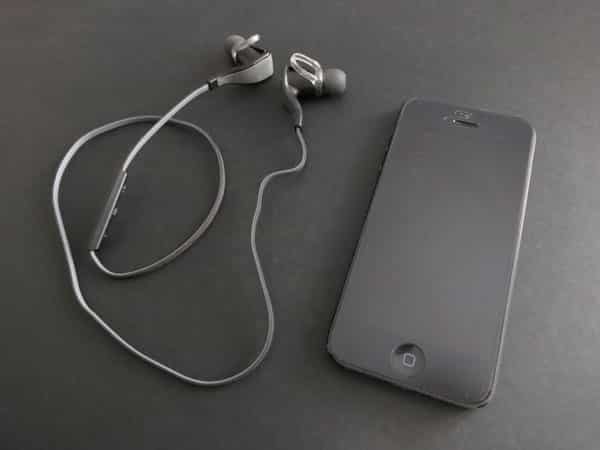
To say that BackBeat GO 2 has a lot in common with BlueBuds X would be an understatement: these could easily be products from the same company, apart from cosmetic and pack-in differences. Both all-plastic models are shaped like slightly oversized in-ear canalphones, using rubber for both interconnecting flat cables and interchangeable ear tips. The cabling is an inch longer on BackBeat GO 2, running 25 inches from end to end, more than enough wiring to run comfortably in front of or behind your neck. Both versions are marketed as sweatproof, with JayBird touting “Liquipel Sweat Repellant Nano Technology” and Plantronics referring to “P2i military-grade nano-coating,” likely the same basic feature under two brand names. Since they both use Bluetooth 2.1 wireless technology, pairing is accomplished solely through your iPad, iPhone, or iPod’s Bluetooth settings menu, and you can pair both headsets to multiple devices without issues.

Apart from aesthetic differences, each component on each model is so similarly located that they appear to be from a common reference design. Each model has a three-button remote and microphone capsule dangling from the right earphone—precisely the same in button and mic placement, though not appearance.
Further confirming their similar origins are nearly identical pop-off caps behind the right earphones, revealing vertically oriented micro-USB ports. Power is activated on both models by holding down the remote’s center multifunction button; volume, play/pause, and track changes can also be made using taps and holds on the controls.

Sonically, these models are so nearly identical that most users would strain to find differences. We noted in our prior review that BlueBuds X’s static is virtually non-existent, while clarity is impressive enough to reveal multiple layers in songs, and audio provided ample treble, mid-treble, midrange, and mid-bass without much thump. BackBeat GO 2 has the same characteristics and general sonic signature, only with modestly deeper bass, making audio sound a little more rich and engrossing at the cost of a tiny bit of high-end treble. JayBird’s signature is a hint more dynamic, but not enough that we or most people would care. Both units emit chimes and occasional voice prompts to signal pairing, power status, and volume changes.

Microphone performance during phone calls was nearly the same between the headsets, as well. One of our two test callers noted no differences whatsoever between them, and couldn’t tell them apart from Apple’s own iPhone 5 microphone under normal listening conditions. The other gave BackBeat GO 2 a small advantage in clarity relative to BlueBuds X. In other words, you’ll do no worse with Plantronics’ headset than JayBird Gear’s for phone calling, and may do a little better.
[Updated August 2, 2013: In extended outdoor testing, we found that BackBeat GO 2’s microphone appears to have issues in areas with significant ambient noise; it performs perfectly in quiet to modestly noisy indoor indoor environments, though.]

The real differences between the models start with cosmetic tweaks: unlike the chrome plus glossy black or white color scheme favored by BlueBuds X, Plantronics picked gray tones to pair with mostly matte black or white components for BackBeat GO 2. We’d give BlueBuds X a small edge on looks, but they’re not much different in size, shape, or weight; BlueBuds X weigh 13.8 grams to BackBeat GO 2’s indistinguishable 14. Then there are the pack-ins: Jaybird’s $170 set comes with a carrying case, three sizes of ear tips, three sets of ear stabilizers, and a charging cable. Plantronics trumps that by offering two slightly different packages, starting with an $80 bundle that includes three sets of ear tips, one set of pre-installed transparent ear stabilizers, a cable, and a wall adapter. A deluxe $100 version adds a combination battery pack and carrying case.

You may actually want that carrying case, as it eliminates BackBeat GO 2’s only on-paper disadvantage relative to its rival. Plantronics’ integrated battery promises 4.5 hours of listening or 5 hours of phone talk time, versus a more impressive 8 hours for BlueBuds X. But the battery case adds an additional 10 hours of run time, notably boosting the headset by an hour after only a 20-minute recharging session. The nylon and fabric case feels sturdy, holds closed with a flap and rubber front strap, and has twin micro-USB connectors.