In response to news articles that have appeared since Apple announced the “new” iPod mini and iPod photo hardware yesterday, iLounge has produced a summary of new iPod facts that may be of use to our readers and journalists alike.
Broadly, How Did the iPod Family Change Yesterday?
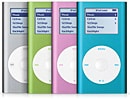
 New iPods: Apple introduced the largest capacity iPod mini ever made – 6-Gigabytes (1,500 songs) instead of 4-Gigabytes (1,000 songs) – and unveiled the smallest capacity iPod photo ever made – 30-Gigabytes (7,500 songs), down from 40-Gigabytes (10,000 songs).
Lower Prices: The company also made bold pricing moves with both its mid-range iPod mini and high-end iPod photo lines, slashing the price of the 4-GB iPod mini to $199 from $249, and even more aggressively cutting the prices of its premium, color-screened iPod photos, which used to sell for $499-599. The new models sell for $349-449, a $150 price difference. Apple’s drop of the 4GB iPod mini’s price to $199 expands its availabilty to an even larger audience, and consequently, there are now iPods at every $50 price point from $99 to $349, increasing steadily in capacity and features.
Discontinued iPods: Apple simultaneously discontinued two 40-Gigabyte iPods, a black-and-white model ($399) and a color iPod photo ($499), as well as an unpopular gold-colored iPod mini, leaving only four color options for that device.
 What Do the Changes Really Mean? The black-and-white full-sized iPod is fading away, as are options in the upper middle range. More powerful iPod photo hardware is now priced to entice a much larger audience, and for the first time in years, the most expensive iPod now sells for under $499. That iPod, the 60GB iPod photo ($449), has twice the storage capacity of the 30GB model that sells for $100 less.
But black-and-white iPods are still selling well, most likely because of their lower prices. Consequently, Apple did not discontinue its black-and-white screened 20GB iPod, or its 4GB iPod mini, the company’s most popular iPod-badged products in 2004. The price of the 20GB iPod ($299) remained the same, and still represents a sizeable capacity jump from the 6GB iPod mini priced at $249.
What About Smaller, Fine Print Changes?
The Positives and Neutrals: As a clear benefit, Apple increased the iPod mini’s estimated battery life from 8 to 18 hours. Neutrally, it modestly strengthened the blue, green, and pink shades used in iPod mini casings, and changed the color of the iPod mini’s Click Wheel print to match its respective casing. At this link, Apple describes the new iPod mini as a “second-generation” iPod mini, and discusses the few cosmetic and other differences we have noted and photographed.
The Consequences: Unfortunately, the company stopped including FireWire cables and FireWire wall chargers with both the iPod mini and the iPod photo; the iPod mini now is charged primarily with an included USB 2.0 cable through a computer’s powered USB 2.0 port, and you can buy a wall charger ($29) separately. The iPod photo includes both a USB wall charger and cable, but no longer includes TV photo playback cables, a Dock, a carrying case, or a FireWire cable.
 Was Anything Else Introduced?
Accessories: Responding to consumer demands, Apple also announced the late March release of a digital Camera Connector ($29), which allows iPod photo users to transfer digital photos directly to the color-screened iPod from a camera, and then view the pictures on the screen without using a computer.