In various sectors and industries IoT and M2M technology are both used and confused at the same time. Many seem to believe that IoT simply consists in adding sensors to the already available M2M solutions in order to collect more or better data, which is not quite the case. The differences between M2M and IoT are in fact fundamental and mostly and have to do with M2M or IoT applications. Let us look at the two concepts separately in order to understand what sets them apart.
What is M2M, or Machine to Machine?
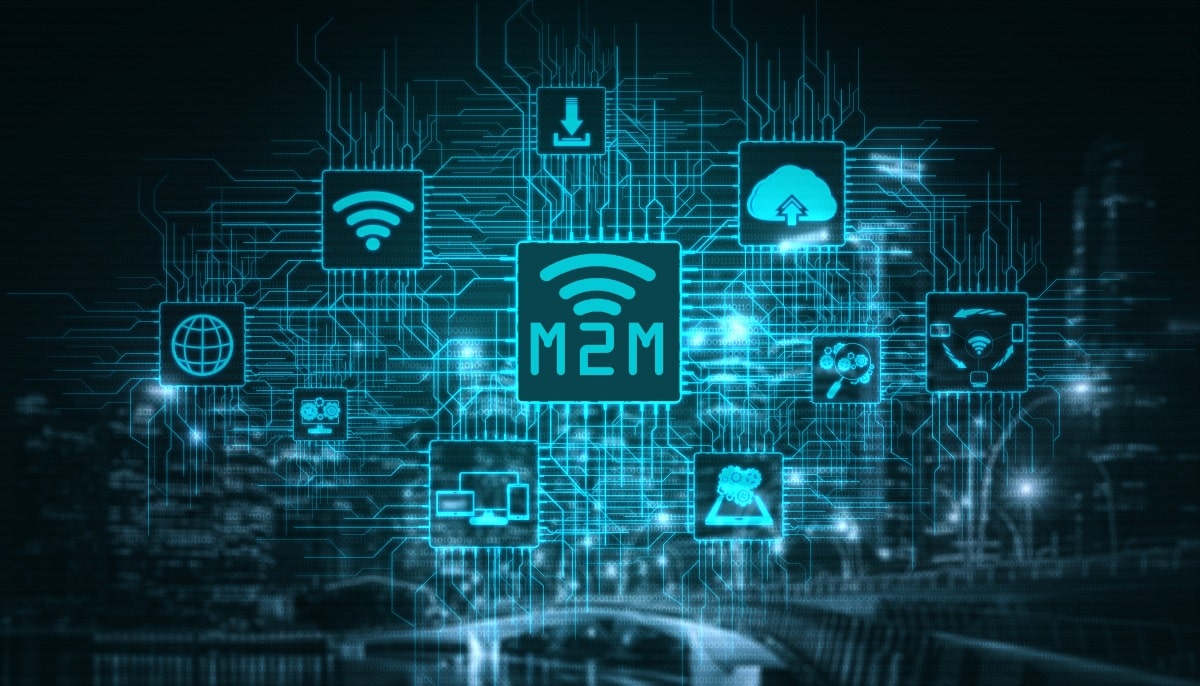
Machine to Machine or M2M is an architecture traditionally used in surveillance, remote control or process optimization. It applies to specific applications and solves one-off issues by offering a one-off solution.
No m2m definition would be complete without a concrete example to bring it to life. Let us take a building. It would normally have several autonomous control systems such as heating and ventilation, surveillance, a fire protection system, etc. These various solutions take similar types of measurements within a similar environment and rely on their own sets of sensors.
These sensors pull out relevant data within different silo hubs, within which communication often follows proprietary norms. Exchange of data is therefore close to impossible.
This also means that M2M is perfect for vertical applications and companies looking to integrate highly specialized but also rather simple architectures into their systems.
Wired or wireless, M2M technology aims to create a loop where relevant data circulates without human intervention.
What is IoT, or Internet of Things?
What are the main differences between M2M and IoT?
Internet of Things or IoT brings together two digital worlds: that of businesses and that of individuals. It can be seen as a sub-system that produces and publishes collected data. Unlike in M2M, there is no dedicated use for the data in question. Instead, it is possible to opt in or out of each data feed in order to cater for the widest possible array of applications.
One of the most important differences between M2M and IoT is the fact that while M2M connects a specific number of data entry points to a finite set of dedicated hubs, IoT connects an infinite number of physical devices to a virtually unlimited data feed through the Internet.
Within the IoT system, connected devices are usually identified through their IP address, much in the same way as a computer is recognized within the web’s IP networks. These machines are given access to a cloud-based platform where every piece of collected data is stored and can both feed and receive information from the system.
So, isn’t IoT simply better than M2M?
While the applications of IoT are potentially much more numerous than what M2M can offer, the openness of this solution is also what could prevent it from being the future of business all by itself. For many businesses, having every piece of information pertaining to their activities be part of big data is simply inconceivable.
Connectivity solutions may seem like something every company, every factory might want. With the right tools, having access to so much information can aid in many important corporate decisions. However, the reverse is rarely as enviable. Most businesses possess private data that they want or need to keep that way. As they run, factories (for instance) not only produce products but also information that they may wish to collect internally in order to analyze it and use the results to streamline their processes. Though sharing all of this with the rest of the world may counter-productive.
The best of both worlds
IoT refers to Internet of Things, and it is exactly that: the use of immense numbers of connected devices to create a world where information can be used to continually improve our lives. M2M often represents the opposite and symbolizes a less forward-thinking business model, which is not truly the case. Instead of focusing on the differences between M2M and IoT, it is more interesting and accurate to see Internet or Things and Machine to Machine technologies as complementary and to get out of the mindset of having to select one over the other. With one being more flexible and the other more secure, it is interesting to use the differences between M2M and IoT to create a tailored system where security is given the place it deserves but where access to supplementary information is not made impossible.
The question should not be “which solution is better?” but rather “which aspect of each solution does my company need?”. Then, IoT and M2M may be implemented side by side to allow businesses to create the ideal approach, perhaps in the form of Industrial Internet of Things, where IoT is given an additional layer of security. That way, companies do not need to deprive themselves of the advantages of automation but do not incur the risk of having their highly important data widely unprotected.