
Snowflake is a robust Data Warehouse built on top of the Microsoft Azure Cloud or Amazon Web Services infrastructure. It is built for the Cloud from the ground up and is available as a Software as a Service (SaaS). Snowflake is an ideal choice for companies that don’t want to spend resources for maintenance, setup, and support of in-house servers since there is no software or hardware to install, manage or configure. You can also read the article from Hevo Data comparing snowflake vs redshift
Understanding the Architecture of Snowflake
Snowflake manages to stand out from the crowd owing to its data-sharing capabilities and architecture. Its architecture allows compute and storage to scale independently, allowing customers to pay for computation and storage independently. It also offers near-infinite scalability of concurrent workloads to easily load, analyze, and integrate data.

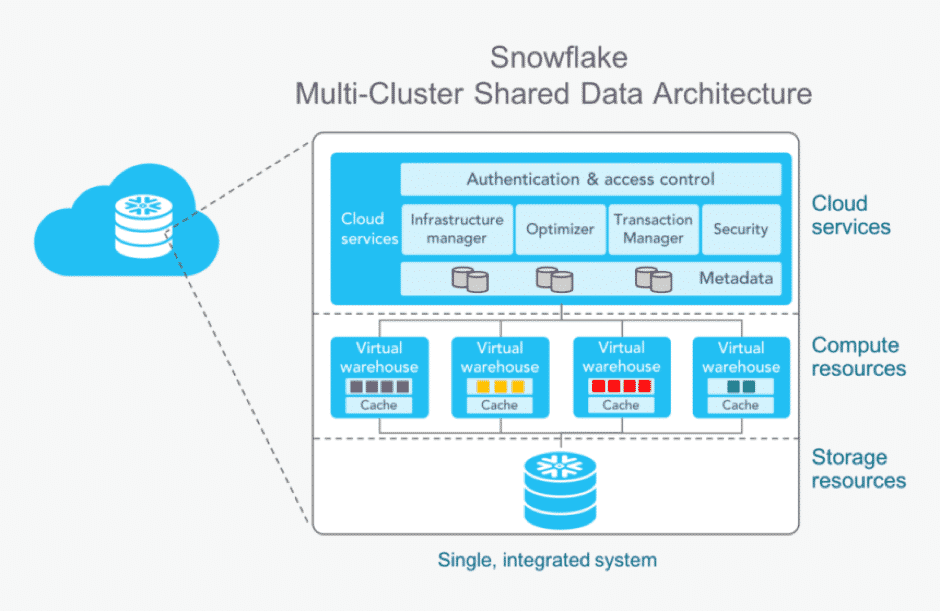
Snowflake’s computation is billed on a per-second basis whereas storage is billed per terabytes per month. Snowflake’s architecture comprises 3 layers as follows:
- Compute Layer: This layer consists of virtual Warehouses or Clusters. These Warehouses execute the data processing tasks needed by queries. Each cluster has access to all the data in the storage layer while working independently. This implies that the clusters don’t have to compete for or share compute resources. This paves the way for automatic and non-disruptive scaling. In layman’s terms, this means that while a query is running, the compute resources can scale without having to rebalance or redistribute the data in the storage layer.
- Cloud Services: The Cloud Services layer is responsible for coordinating the entire system. It eliminates the need for manual Data Warehouse tuning and management. It also offers numerous services as follows:
- Infrastructure Management
- Authentication
- Access Control
- Metadata Management
- Query Optimization and Parsing
- Database Storage: This layer holds all the data loaded into Snowflake that includes semi-structured and structured data. Snowflake manages all aspects of data storage: file size, structure, organization, metadata, compression, and statistics. The Database Storage layer runs independently of compute resources.
Understanding the Benefits of Snowflake
Snowflake deals with and eliminates various challenges put forth by older hardware-based Data Warehouses such as data transformation issues, limited scalability, and failures or delays due to high query volumes. By abstracting the complexity of the underlying Cloud infrastructures, Snowflake allows you to seamlessly run your data solution across multiple Clouds and Regions for consistency. Snowflake offers numerous other benefits to your business, a few of which have been highlighted below:
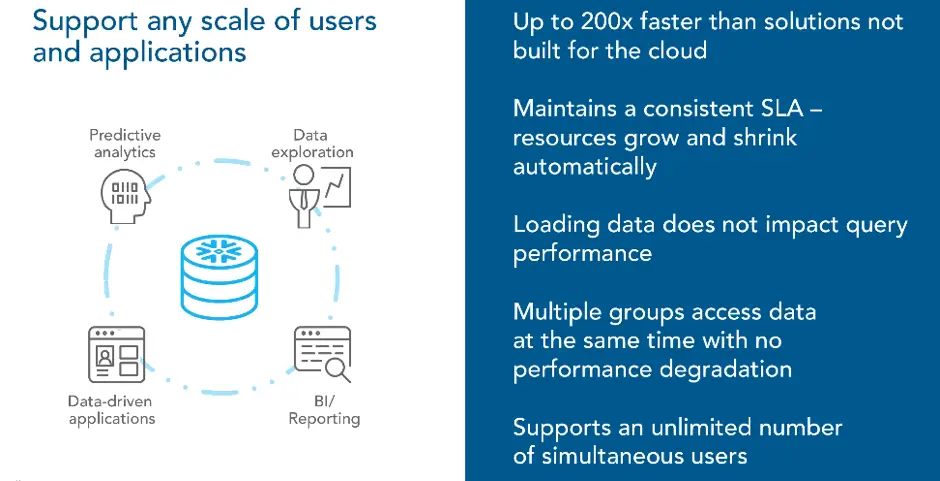
- Accessibility and Concurrency: A traditional Data Warehouse might run into concurrency issues when too many queries execute and compete for resources. Snowflake addresses this with its multi-cluster architecture. In this architecture, queries from one virtual warehouse aren’t affected by the queries of another warehouse and each virtual warehouse can scale down or up as required. Data analysts and data scientists can get what they need without having to wait for other processing and loading tasks to complete.
- Speed and Performance: You can scale up your virtual warehouse to take advantage of scalable compute resources owing to the elastic nature of the Cloud. You can use this to run a high volume of queries or load data faster. Later the Data Warehouse can be scaled down, and you will only have to pay for the time it was used.
- Availability and Security: Snowflake is distributed across availability zones supported by the platform (Azure or AWS) leveraging it. It is designed to tolerate network & component failures and operate continuously with minimal impact on customers. Snowflake ensures data security by providing encryption across all network communications and support for PHI (Protected Health Information) data for HIPAA customers.
- Seamless Data Sharing: Snowflake enables data sharing among its users through reader accounts that can be created directly from the user interface. It allows the provider to create and manage a Snowflake account for the consumer as well.
- Support and Storage for Semistructured and Structured Data: Snowflake allows you to unify semi-structured and structured data for analysis and load it to the Cloud database without transforming or converting it to a fixed relational schema first. Data querying and storage are automatically optimized according to your needs.
Conclusion
This article encapsulates a brief overview of Snowflake highlighting its unique architecture and the key benefits it offers.