Be it the Terminator, Bladerunner, The Matrix, or your favorite episode of Black Mirror, the topic of transhumanism and superhumans is something many people have been fascinated with for centuries. For the oblivious ones out there, transhumanism is a sort of ideology that promotes the merging of technology and the human body. The term is broader than that in reality, but let’s keep it simple for now.
First-world countries like Canada, the U.S., Japan, and Western European countries have more opportunities to advance on this path since they are on top of Abraham Maslow’s hierarchy of needs. Don’t know what that is? You’ve probably learned it in school already, but if the memory’s hazy, check out a reliable paper writing service for students of needs and general information.

So, how close are we as a species to becoming cyborgs? We’ve compiled some groundbreaking inventions that defy the present times, but the question remains. Here’s the list:
1. CRISPR Technology
Not exactly cyborg technology, but an honorable mention nonetheless. Transhumanism at its finest. CRISPR technology refers to the CRISPR Cas-9 gene-editing method that was developed by Jennifer Doudna in 2021. She’s an American molecular biologist. She won a Nobel prize in chemistry in 2020. She’s basically a genius.
So, what exactly is this technique? Well, to break it down in simple and clear terms it’s the copy-pasting of genes with the purpose of adding or removing genetic markers. Why? To remove any genetic diseases that reside in the DNA or to change genetic traits for aesthetics.
With great power comes a lot of rules. The scientific community has basically banned the birth of edited embryos. Meaning no Crispr babies are allowed just yet. Science and ethics always clash and have been clashing for a while. Regulations are often fueled by religion or culture, and this is an interesting and vast topic to be discussed.
For students who need an idea for their next essay topic, why not scroll through religion essay topics on the web. Figure out how religion shapes other aspects of everyday life in different parts of the world, like religion and science, for example.
On that note, one Chinese scientist tried his luck and allowed the birth of two Crispr babies called Lulu and Nana. Jiankui, the aforementioned scientist, modified their genes so that they’d be immune to HIV because their father carried the virus.
He’s been punished and even disallowed from any experimenting. And since he’s in China, who knows how much surveillance he’s under now. Did he do wrong, or was it a noble and courageous act? We do hope for the safety of Jiankui.
2. Bioprinting
Okay, before we dish out the scientific terms, here’s a brief definition of what bioprinting is: Essentially, bioprinting is the merging of biology and 3d printing technology. It’s 3d printing biological material. On top of that, bioprinting is also used to create implants and prostheses for patients who need extra and artificial body parts.
Bioprinting can be considered one of the thriving sectors in medicine and technology that will propel us forward to a future of transhumanism. It’s an important stepping stone. However, it’s still in its early stages and definitely not as it is in the sci-fi shows on your streaming services.
Nonetheless, bioprinting has revolutionized the medical and technological sectors. Bioprinters are:
- Automated: Bioprinters can store, share and provide a ton of data. Data stored in cloud networks. This makes scientists’ lives much easier.
- Dynamic: Bioprinters can multitask.
Bioprinters have made processes that would otherwise take ages in the past, doable in a much shorter period of time. Let’s see how this sector evolves in the years to come.
3. Bionics
Undoubtedly, the field of bionics is an indication of how close we are to becoming ‘cyborgs’. Before we get into the details, let’s look at the description first.
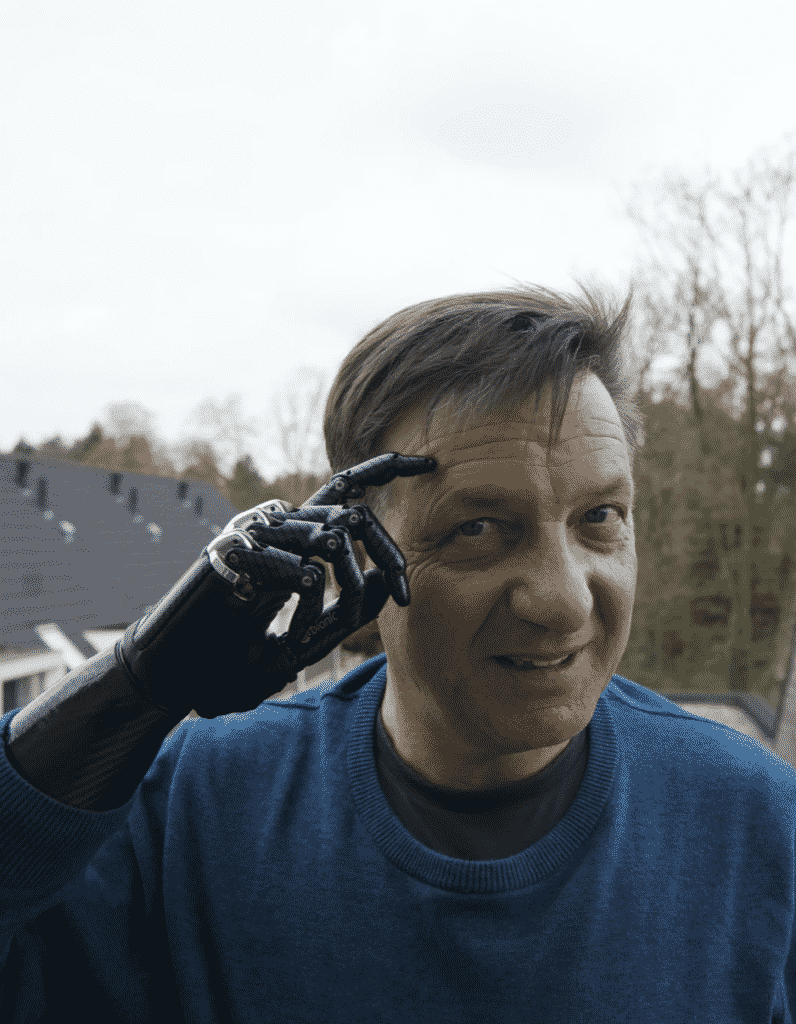
Bionics is a field that studies biology to create synthetic body parts that serve to replace broken body parts, and also serve to enhance human capabilities by supplying extraordinary capability-enhancing artificial body parts.
Think cyborgs and all of the half-human, half-robot characters in sci-fi shows. Bionics is basically transhumanism 101 since the ultimate goal is to merge our natural bodies with non-organic technologies to make us superhuman ‒ or at least something that resembles that vision.
So, the most exciting inventions we could dig up in this sector are:
- Exoskeletons: These are basically armor suits. The ones being developed were made to help soldiers be stronger and last longer. And while this sounds very cool, most of the ones that have been tested have failed to live up to their expectations. Look it up.
- Fortis Suit: A power suit created by Lockheed Martin. It’s been successfully distributed to workers in manual labor. They’ve been using it to carry heavier loads that humans couldn’t possibly achieve.
Our hope for the future is that these inventions become more commercialized. More for the people. However, commercializing some of these inventions may spell trouble, since they can be dangerous tools if they fall in the wrong hands. Will we see a future of regulated use for robotic body parts? Who knows.
4. Neuralink
We can’t be the only ones thinking Elon Musk is the main character and we’re just living in his world/plot sometimes. It’s hard not to be impressed or at the other end of the spectrum, terrified when reading about his most recent shenanigans.
We know you’ve all probably heard of SpaceX and Tesla, but Musk is running more companies than just those two. This year, Musk and his crew from his company called Neuralink, were successful in implanting a micro-sized chip into the brain of a monkey. Now, why would they do this? So the monkey could play computer ping pong with its brain. Okay no, that probably wasn’t the end goal, but that’s what they did.
Now, we know that sounds like some horror sci-fi scenario where Elon Musk is the mad scientist, but it actually did happen earlier this year, with the video of the chimp published in April 2021.
We’re not certain what Elon Musk’s real intentions with this revolutionary but also scary technological advance is, but according to what he says to the public, he thinks it’s an important step to the long-awaited ‘unity’ of humans and computers.
Although many things could definitely go wrong with this sort of technology, it could actually propel us forward to future possibilities beyond our imaginations. Positive possibilities, that is. It’s all on us and him now to shape where we’re going to go with it. Dystopia or Utopia?
Final words
Overall, even though scientists and innovators alike are making huge strides in technology and medicine, we don’t think humans will reach cyborg status that soon yet. But it’s honestly a moot argument at this point since we never know what the future holds. Everything is becoming modernized, and we’re developing at a speed that is unprecedented. At the end of the day, we need technology to serve and help us, and not to destroy us.