

The world of diamond classification has long operated on rigid systems designed to categorize gems into neat, predictable categories that facilitate trade, valuation, and scientific study. However, a subset of pink diamonds has emerged that actively rebels against these established systems, displaying characteristics so unusual and variable that they challenge the fundamental assumptions underlying modern gemological classification methods.
The Champagne Color Phenomenon
Within the already exclusive world of pink diamonds exists an even rarer subset that displays champagne-colored overtones, creating color combinations that exist nowhere else in the gemstone kingdom. These extraordinary gems exhibit primary pink coloration enhanced by secondary champagne, brown, or golden hues that shift and change depending on lighting conditions and viewing angles.
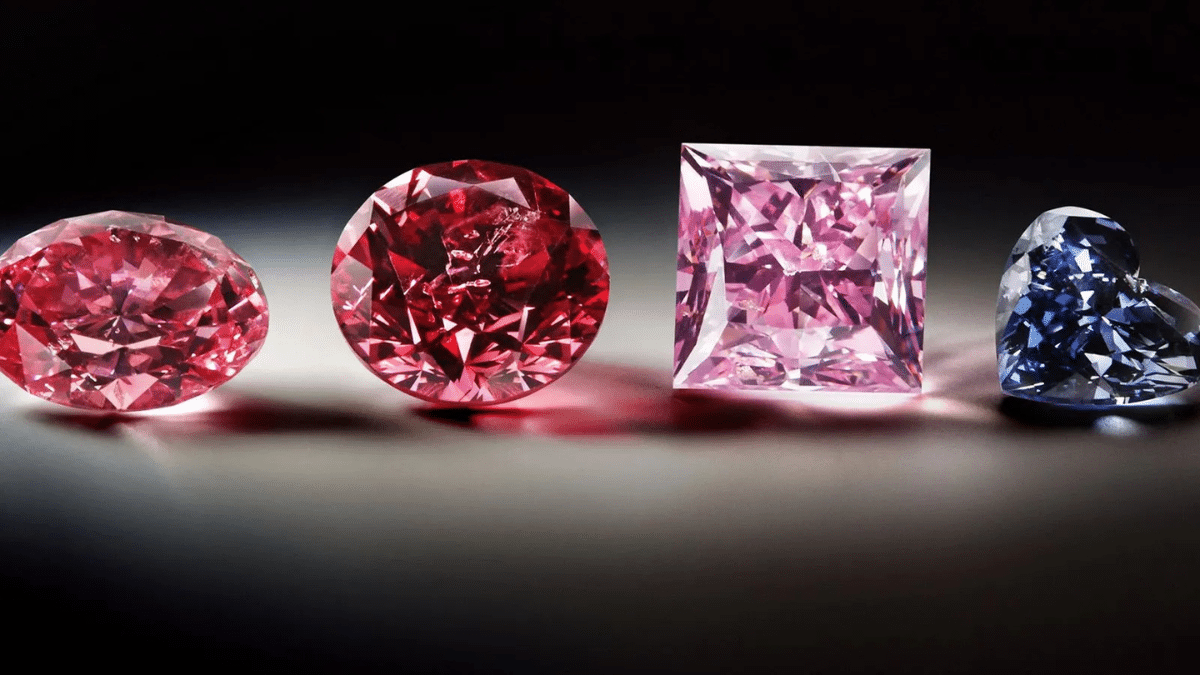
The champagne component in these rebellious pink diamonds appears to result from a completely different formation mechanism than the structural deformation responsible for the pink coloration. This dual-origin coloration creates optical effects that are essentially impossible to replicate artificially, as it requires the precise convergence of multiple geological processes occurring at different times in the diamond’s history.
Traditional color grading systems, designed for stones with single-origin coloration, prove completely inadequate when applied to champagne-tinted pink diamonds. The interaction between pink and champagne coloration creates tertiary hues that don’t exist on conventional color wheels, forcing gemologists to develop entirely new descriptive terminology and grading methodologies.
The champagne rebellion extends beyond simple color classification into the realm of optical behavior. These diamonds often display pleochroism the property of showing different colors when viewed from different directions that varies unpredictably between individual stones. This optical variability makes standardized grading nearly impossible, as the same stone may appear significantly different under various viewing conditions.
Classification System Failures
The Gemological Institute of America’s standardized color grading system, which has successfully categorized millions of diamonds over decades, encounters fundamental limitations when applied to rebellious pink diamonds. The system’s reliance on controlled lighting conditions and standardized viewing angles breaks down when dealing with stones that change appearance dramatically under different circumstances.
International diamond trading terminology lacks adequate vocabulary to describe the complex color interactions observed in champagne-tinted pink diamonds. Terms like “Fancy Vivid Pink” or “Fancy Deep Pink” become meaningless when applied to stones that may appear pink in daylight, champagne under incandescent lighting, and brown under fluorescent illumination.
The rebellion against classification extends to clarity grading, as the structural deformations that create pink coloration often produce internal characteristics that don’t fit standard inclusion categories. These diamonds may contain deformation-related features that technically qualify as inclusions but don’t affect the stone’s beauty or durability in ways that traditional clarity grades would suggest.
Cut grading systems also struggle with rebellious pink diamonds, as traditional proportions and angles may not optimize the complex color interactions present in these stones. The interplay between pink and champagne coloration requires cutting approaches that differ significantly from those used for colorless or single-colored diamonds.
Market Confusion and Opportunities
The classification rebellion of champagne-tinted pink diamonds creates significant challenges in the commercial marketplace, where buyers and sellers require standardized terminology and grading systems to conduct transactions. The absence of universally accepted grading standards for these stones leads to confusion, inconsistent pricing, and disputes over quality assessments.
However, this same classification difficulty creates unique opportunities for collectors and investors who understand the exceptional nature of these rebellious gems. The inability to fit them into conventional categories often results in undervaluation by traditional market participants, creating acquisition opportunities for those with specialized knowledge.
The uniqueness of each rebellious pink diamond means that no two stones are truly comparable, making traditional comparative pricing models ineffective. This situation requires individual assessment and valuation approaches that consider the specific characteristics of each stone rather than relying on standardized market comparisons.
Scientific Investigation Challenges
Research into the formation and characteristics of rebellious pink diamonds faces significant methodological challenges due to their resistance to classification. Traditional scientific studies rely on the ability to group similar specimens for comparative analysis, but the extreme variability of these stones makes such grouping virtually impossible.
Spectroscopic analysis of champagne-tinted pink diamonds produces results that don’t match any existing reference standards. The complex interaction between different coloration mechanisms creates absorption spectra that are unique to individual stones, making species identification and origin determination extremely difficult.
The temporal aspects of rebellious pink diamond formation with different color components developing at different times require analytical techniques that can distinguish between formation events that may be separated by millions of years. This temporal complexity exceeds the capabilities of most standard gemological testing procedures.
Technological Limitations
Advanced analytical equipment designed for conventional diamond analysis often proves inadequate when applied to rebellious pink diamonds. The assumption that diamond properties should be consistent and predictable underlies most testing protocols, but these stones violate such assumptions at fundamental levels.
Computer modeling of optical properties in rebellious pink diamonds fails to produce accurate predictions due to the complex interactions between multiple coloration mechanisms. The software algorithms used for conventional diamond analysis cannot account for the unpredictable color interactions observed in these exceptional stones.
Photography and digital imaging of rebellious pink diamonds present unique challenges, as no single lighting condition or camera setting can accurately capture their full range of color variation. This imaging difficulty complicates documentation, trading, and scientific study of these gems.
Cultural and Historical Context
The rebellion of certain pink diamonds against classification systems reflects broader challenges in human attempts to categorize and understand the natural world. Throughout history, exceptional natural phenomena have forced revisions to established classification systems, leading to advances in scientific understanding and methodology.
The champagne rebellion specifically highlights the limitations of Western gemological classification systems when applied to phenomena that don’t conform to European aesthetic and scientific traditions. Alternative classification approaches used in other cultures might prove more adequate for describing these complex gems.
Educational Implications
The existence of pink diamonds that refuse classification creates significant challenges for gemological education programs. Traditional curricula based on systematic classification methods must be supplemented with approaches that accommodate exceptional cases and methodological limitations.
Students studying rebellious pink diamonds must learn to think beyond established categories and develop flexible analytical approaches that can adapt to unique circumstances. This educational shift represents a fundamental change from rote memorization of classification systems toward development of critical thinking and adaptability skills.
Future Developments
The rebellion of certain pink diamonds against classification systems is driving development of new analytical techniques and grading methodologies that may ultimately benefit the broader gemological community. These innovations could lead to more flexible and accurate classification systems for all gemstone varieties.
Artificial intelligence and machine learning technologies show promise for developing classification systems that can accommodate the complexity and variability of rebellious pink diamonds. These technologies could potentially identify patterns and relationships that escape human observation and analysis.
Philosophical Implications
The champagne rebellion ultimately raises fundamental questions about the nature of classification itself. The existence of natural phenomena that resist categorization challenges the assumption that the natural world can be completely understood through systematic classification approaches.
These rebellious gems serve as reminders that nature’s creativity often exceeds human organizational systems, creating phenomena that demand new ways of thinking and understanding. Rather than viewing their resistance to classification as a problem to be solved, perhaps we should appreciate it as evidence of nature’s infinite capacity for creating unique and extraordinary beauty that transcends human attempts at categorization.
The ongoing rebellion of these exceptional pink diamonds ensures that gemology will continue to evolve and develop new approaches to understanding and appreciating the full spectrum of natural phenomena, making the field more dynamic and responsive to the complexities of the natural world.