It’s hard to ignore how much the internet has changed. When you read a LinkedIn post, a student essay, or an Amazon review, you might wonder: Did a person really write this?
We’re now surrounded by “good enough” content made by large language models. Tools like ChatGPT and Claude are helpful, but they’ve made things harder for editors, teachers, and hiring managers who care about real, authentic writing. A reliable AI detector is no longer just for catching cheaters—it’s about keeping trust in what we read.
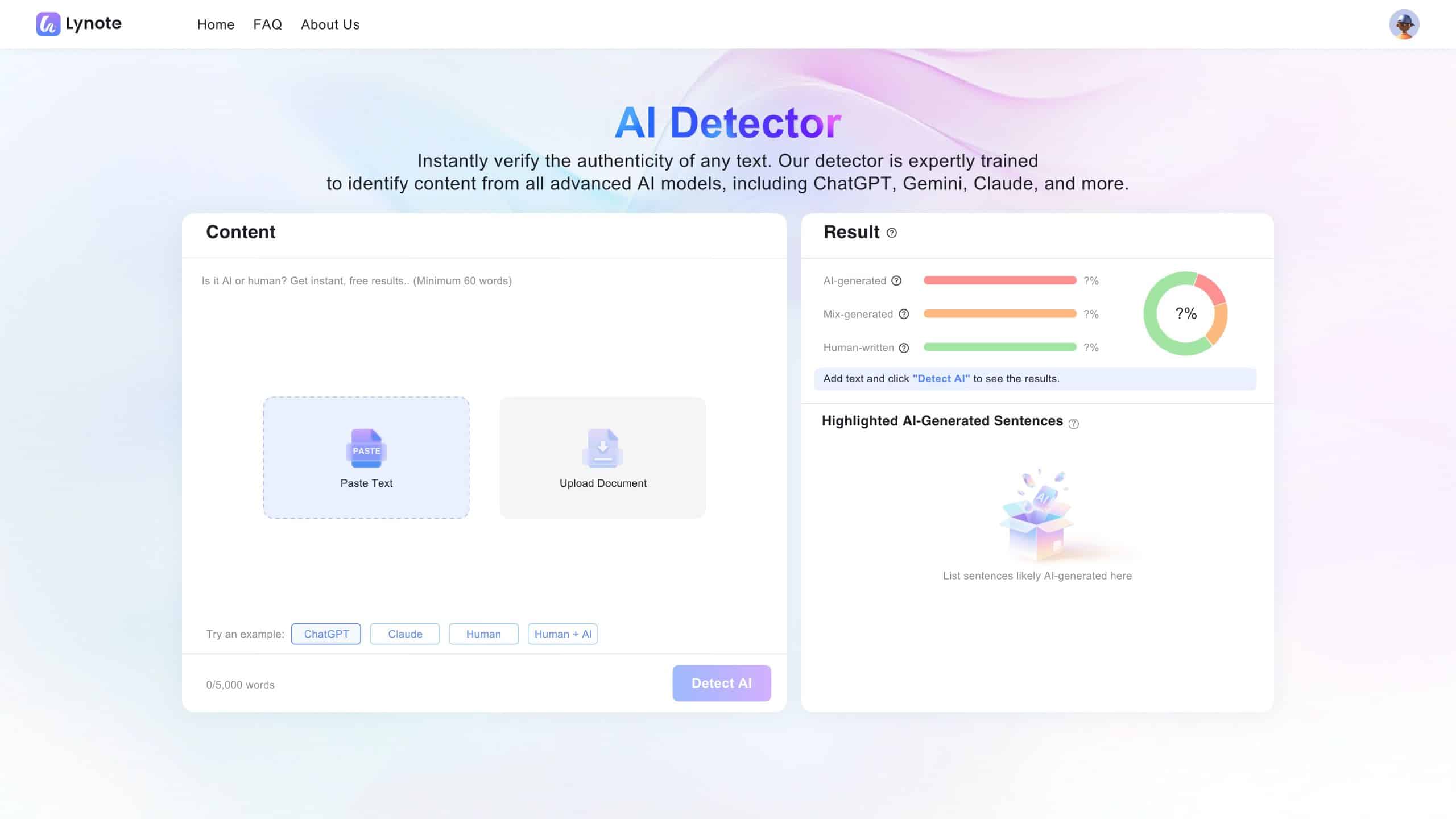
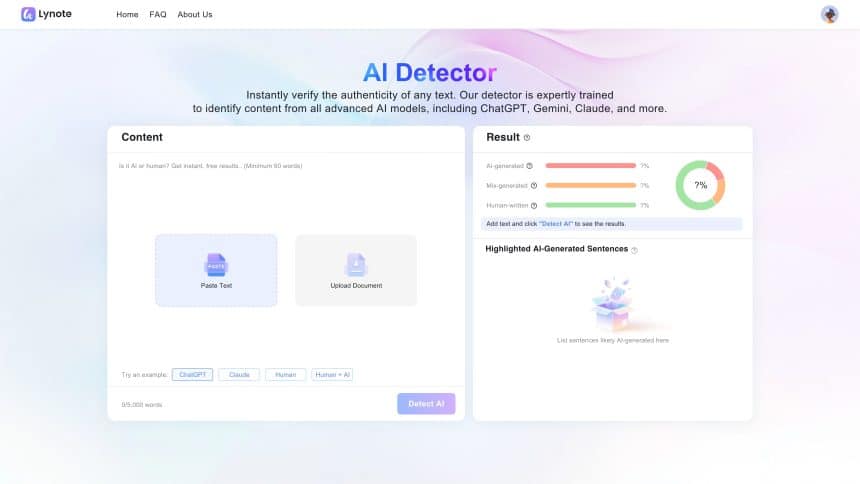
This is the gap Lynote.ai is trying to fill. It isn’t just another generic checking tool; it’s a platform built for the reality of 2025, where AI is more intelligent, sneakier, and harder to spot than ever before.
Why Most Detectors Fail (And Why This One is Different)
If you’ve tried free AI detection tools, you know how frustrating they can be. Sometimes, your own writing gets flagged as half AI. Other times, clear AI-generated text isn’t caught at all.
The problem is that older detection models look for simple keywords. Lynote.ai takes a different approach. It claims a 99% accuracy rate, but what’s more interesting is how it gets there. The engine analyses the text for specific linguistic signatures—syntax patterns, “perplexity” (how surprised the model is by the text), and “burstiness” (the variation in sentence structure).
Humans write with a chaotic rhythm; we mix short sentences with long, winding ones. AI tends to be perfectly, boringly consistent. Lynote’s AI detector is trained on the newest models—including GPT-5 candidates, Gemini, and Claude—to spot that robotic perfection, even when a user tries to hide it.
Beating the “Humanisers”
This has become a back-and-forth challenge in tech. As soon as detectors improve, people use paraphrasing tools to get around them. They might ask AI to write like a fifth grader or add mistakes to fool the system.
Lynote.ai has focused on solving this problem. Its system looks beyond simple changes and finds the deeper structure of the text. Even if someone changes words or the order, the AI pattern is often still there. For editors and teachers, a tool that can catch “humanised” AI writing makes a big difference.
More Than Just a Score
One smart choice Lynote made is not giving a simple “real or fake” answer. Real life is rarely that clear-cut.
When you run text through Lynote, you get an “AI Prediction Map.” It colour-codes the document sentence by sentence. This is incredibly useful for a collaborative workflow.
For instance, if you are a content agency, you might allow writers to use AI for outlining but not for drafting. Lynote lets you see exactly where the line was crossed. It highlights specific paragraphs that need a human touch, turning the tool into a writing coach rather than just a policeman. It also handles multiple languages—Spanish, French, German—which is essential given that the AI content flood is a global phenomenon.
The Privacy Factor
There is one other detail that deserves a mention, especially for enterprise users. A lot of free detection tools are essentially data traps—they take the text you paste and use it to train their own models. If you are checking confidential legal documents or proprietary code, that’s a nightmare.
Lynote.ai is GDPR compliant and explicitly states that it doesn’t store your input or use it for training. It’s a boring detail, but for anyone working in HR, law, or corporate comms, it’s the detail that matters most.
The Verdict
AI is here to stay, and we won’t return to a world without it. As machine-generated text becomes more common, human insight is more valuable than ever. We need tools that help us distinguish between a quick AI summary and genuine human ideas.
Whether you want to protect your website’s SEO or make sure a job applicant wrote their own cover letter, Lynote.ai gives you the accuracy you need. It’s a smart, secure, and detailed AI detector for today’s world.