
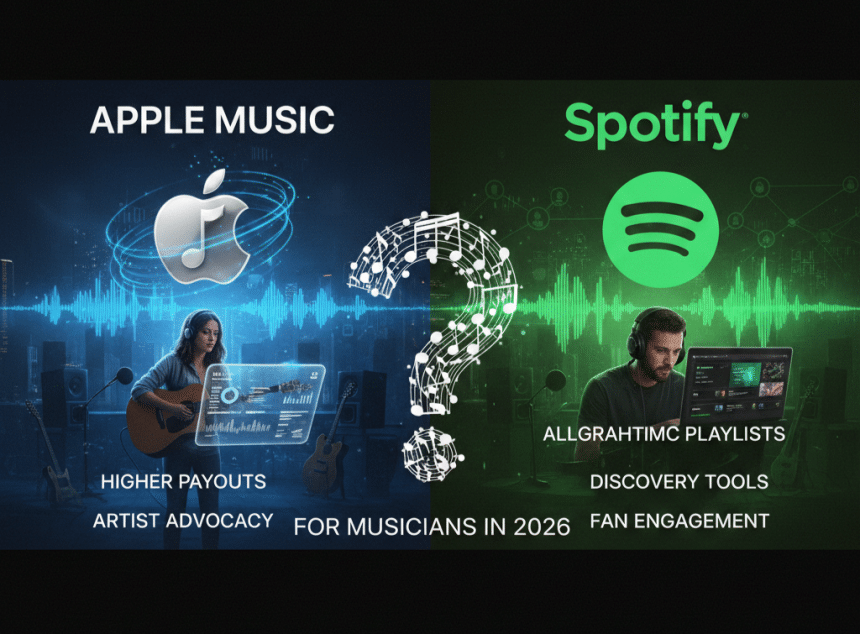
A Technical Analysis of Royalties, Discoverability, and Platform Economics from the Artist Perspective
The streaming music wars have largely been framed from the consumer perspective—which service has better sound quality, more features, or superior recommendation algorithms. But for the musicians whose work powers these platforms, the calculus is entirely different. Artists don’t choose between Apple Music and Spotify based on interface aesthetics or playlist curation. They care about payment rates, discoverability mechanisms, audience reach, and which platform provides better tools for building sustainable careers.
This analysis examines both platforms through the lens that actually matters to musicians: economic viability and career infrastructure. The findings reveal that neither platform is universally “better”—each has distinct advantages that make the real answer more nuanced than Apple enthusiasts or Spotify defenders might prefer to acknowledge.
For musicians navigating the streaming economy in 2026, the strategic imperative isn’t choosing one platform over the other—it’s understanding how to optimize presence on both while routing audiences efficiently regardless of their platform preference. The technical and economic realities of modern music distribution make multi-platform strategy essential, not optional.
The Royalty Rate Reality: Breaking Down What Artists Actually Earn
The most frequently cited difference between Apple Music and Spotify is payment per stream, but these figures are often misunderstood or misrepresented. Neither platform pays a fixed rate per stream. Both use pro-rata models where artists receive a percentage of platform revenue proportional to their share of total streams.
Apple Music’s Payment Structure:
Apple Music generally pays higher per-stream rates than Spotify, with independent artists typically receiving $0.006-0.010 per stream. This higher rate stems from several factors:
- Subscriber-Only Model: Apple Music has no ad-supported free tier. All users pay subscriptions, generating higher revenue per user than Spotify’s mixed model.
- Premium Pricing: Apple Music subscriptions cost the same or slightly more than Spotify Premium in most markets.
- Geographic Distribution: Apple Music’s user base skews toward higher-income markets (US, UK, Western Europe, Japan) where subscription prices are highest.
- Lower Platform Cut: While both platforms retain approximately 30% of revenue, Apple Music’s integration into the broader Apple ecosystem means different cost structures.
Spotify’s Payment Structure:
Spotify’s per-stream rates are lower, typically $0.003-0.005 for independent artists. This reflects:
- Free Tier Economics: Approximately 60% of Spotify’s users use the ad-supported free tier, which generates significantly less revenue per stream than premium subscriptions.
- Global Reach: Spotify operates in more markets, including emerging economies where subscription prices are substantially lower to match local purchasing power.
- Market Dynamics: Spotify’s larger user base means more total streams but lower average payment per stream due to free-tier dilution.
Using a Spotify Royalty Calculator reveals the practical implications: An artist generating 100,000 streams monthly on Apple Music might earn $600-1,000, while the same 100,000 streams on Spotify generates $300-500. This 2:1 ratio is significant but doesn’t tell the complete story.
The Distribution Chain’s Impact:
What artists ultimately receive depends on the entire payment chain:
- Platform pays rights holder (label or distributor)
- Distributor takes their cut (0-15% depending on service)
- Label takes their percentage (if artist is signed)
- Publishing royalties split off (10-15% for songwriters)
- Artist receives remainder
An independent artist using DistroKid (0% commission) retains nearly all the performing artist share. An artist signed to an unfavorable label deal might receive only 15-20% of the original per-stream payment regardless of platform.
This means platform choice matters less than deal structure. An artist keeping 85% of Spotify’s $0.004 per stream ($0.0034) earns more than an artist keeping 20% of Apple Music’s $0.008 per stream ($0.0016).
Audience Reach: Why Platform Size Matters
Payment rates are meaningless without audience reach. Apple Music’s higher per-stream rates don’t compensate for Spotify’s substantially larger user base.
Spotify’s Market Dominance:
- 602 million total users (as of Q4 2024)
- 236 million premium subscribers
- Available in 184+ markets
- Dominant platform in most global markets
Apple Music’s Market Position:
- 88 million subscribers (as of 2024)
- No free tier, all users are paying subscribers
- Available in 167 countries
- Strong presence in Apple ecosystem markets (US, UK, Japan)
The user base disparity is substantial—Spotify has roughly 6.8x more total users and 2.7x more paying subscribers. For musicians, this translates directly to discovery potential. A song that reaches 1% of each platform’s user base reaches 6 million people on Spotify versus 880,000 on Apple Music.
However, Apple Music’s audience quality arguably compensates for smaller quantity. Apple Music subscribers are all paying customers, suggesting higher engagement and spending capacity. Spotify’s free-tier users are more passive listeners who generate minimal revenue per stream.
Strategic Implications for Musicians:
Artists can’t realistically choose one platform exclusively. Spotify’s reach provides discovery and volume. Apple Music’s payment rates provide better per-stream economics for the audience that does discover the music. Optimal strategy requires strong presence on both platforms while understanding their different roles in career development.
Discoverability Mechanisms: How Each Platform Helps Artists Get Heard
Streaming success depends substantially on discoverability—how platforms surface music to listeners who don’t already know about artists. Apple Music and Spotify use fundamentally different approaches.
Spotify’s Algorithmic Discovery:
Spotify has invested heavily in recommendation algorithms that power:
Discover Weekly: Personalized playlists delivered every Monday with 30 songs matched to individual listening patterns. For artists, placement here can generate 50,000-500,000+ streams weekly depending on how many users receive the recommendation.
Release Radar: Personalized playlists featuring new releases from artists users follow plus algorithmically suggested new releases. Critical for artists because it guarantees engaged listeners (existing followers) see new releases.
Radio: Algorithmic stations based on songs, artists, or playlists that continue playing similar music. Provides passive discovery as listeners who find one song get exposed to related artists.
Daily Mix: Personalized playlists combining familiar favorites with similar new discoveries. Balances comfort with exploration.
Spotify’s algorithm is highly responsive to engagement signals. Artists whose music generates strong engagement (high save rates, playlist adds, completion rates, low skip rates) receive algorithmic amplification. This creates potential for exponential growth—algorithmic placement generates streams which generate more engagement signals which trigger more algorithmic placement.
The downside is opacity and lack of control. Artists can’t directly influence algorithmic decisions beyond creating music that generates strong engagement. The system is also prone to rich-get-richer dynamics where established artists with existing engagement receive preferential algorithmic treatment.
Apple Music’s Curated Discovery:
Apple Music emphasizes human curation over algorithms:
Editorial Playlists: Apple’s editorial team curates genre-specific, mood-based, and activity-focused playlists. These playlists are updated regularly with human judgment about quality and fit.
Apple Music 1/2/3 Radio: Live radio programming with human DJs providing context and personality. Evokes traditional radio’s discovery function but in streaming context.
New Music Daily: Flagship playlist showcasing new releases across genres, curated by Apple’s editorial team.
Genre-Specific Showcases: Dedicated playlists for hip-hop, country, rock, electronic, and other genres where editors highlight releases they consider noteworthy.
Apple’s curatorial approach provides advantages and disadvantages. Human curation can identify quality that algorithms miss and provides the validation of expert approval. However, it’s less scalable—editors can only evaluate a fraction of new releases, making discovery more competitive and opaque.
Apple Music does use algorithms for personalized recommendations (Listen Now suggestions, station features), but these play a secondary role compared to Spotify’s algorithm-first approach.
Discoverability Advantage Assessment:
Spotify’s algorithmic approach provides more pathways for emerging artists to gain traction without industry connections or label support. Artists who create engaging music can trigger algorithmic promotion that reaches substantial audiences.
Apple Music’s curatorial approach potentially provides more credibility and prestige but creates higher barriers for artists without industry relationships or existing visibility. Editorial selection requires catching curator attention, which often requires existing momentum, publicity, or industry connections.
For most independent artists, Spotify’s algorithmic pathways provide more accessible discovery opportunities. However, Apple Music editorial placement carries cachet that can influence industry perception and booking opportunities.
Platform Tools for Artists: Infrastructure and Analytics
Both platforms provide artist-facing tools, but with different emphases and capabilities.
Spotify for Artists:
Spotify’s artist dashboard provides extensive capabilities:
Analytics Dashboard: Detailed metrics including:
- Listener demographics (age, gender)
- Geographic breakdown showing where listeners are located
- Traffic sources (algorithmic playlists, editorial playlists, user playlists, search, artist profile)
- Listener behavior (saves, playlist adds, skip rates)
- Historical trends showing growth patterns
Playlist Pitching: Artists can pitch unreleased tracks to Spotify’s editorial team for playlist consideration. Submission requires providing context (genre, mood, release story, promotional plans) that helps editors evaluate fit.
Profile Customization: Artists control their profile appearance, artist pick (featured playlist or track), and can upload videos and images.
Promotional Tools: Spotify provides shareable links, codes, and embeddable players for external promotion.
Discovery Mode: Experimental feature where artists accept lower royalty rates in exchange for algorithmic promotion, controversial among musicians who view it as exploitative.
Apple Music for Artists:
Apple’s artist dashboard is less extensive but provides core functionality:
Analytics: Metrics including:
- Plays and listeners over time
- Geographic data showing where music is popular
- Song and album performance comparisons
- Playlist placements showing which Apple Music playlists feature the music
- Shazam data (since Apple owns Shazam) showing discovery through that channel
Profile Management: Artists can customize their profile, upload artwork, and feature specific releases.
Milestones: Apple highlights achievement milestones (streams, listeners, playlist adds) that artists can share for promotional purposes.
The analytical gap is significant. Spotify provides substantially more data, particularly around listener demographics and behavioral patterns that inform strategic decisions. Apple Music’s analytics are adequate for understanding basic performance but lack depth for sophisticated strategy development.
For data-driven artists who optimize releases based on performance insights, Spotify’s superior analytics create meaningful advantage.
Genre Classification and Search: The Hidden Discoverability Factor
Both platforms use genre classification systems to organize music and inform recommendations, but Spotify’s approach is significantly more sophisticated—and more consequential for artist discoverability.
Spotify’s Micro-Genre System:
Spotify has classified music into over 6,000 micro-genres using machine learning analysis of audio characteristics combined with listening behavior data. Artists might think they’re making “indie rock” but Spotify has algorithmically determined they’re “stomp and holler” or “modern alternative rock.”
These micro-genre classifications influence everything about discoverability:
- Which algorithmic playlists might feature the music
- What appears in genre-based searches
- Which artists appear as “similar artists”
- How recommendations are generated
Most artists have no visibility into how Spotify has classified their music, creating optimization blind spots. Tools like the Spotify Genre Ranker reveal these hidden classifications, showing artists exactly which micro-genres Spotify has assigned them to and where they rank within those categories.
Understanding genre classification is crucial because it determines competitive positioning. An artist classified as “indie rock” (an enormous category with intense competition) faces different discovery challenges than an artist classified as “indie poptimism” (a smaller, more specific niche with less competition but more targeted audience).
Keyword Search Optimization:
Spotify’s search algorithm responds to metadata optimization—track titles, album names, artist descriptions, genre tags. Artists who understand which keywords drive searches and optimize accordingly improve discoverability.
The challenge is knowing which keywords matter. An artist might optimize for “indie folk” without realizing that “modern folk” or “indie acoustic” drives more searches in their target demographic.
Search rank tracking provides this intelligence, showing which keywords artists rank for and identifying optimization opportunities. An artist might discover they rank poorly for high-volume searches but well for long-tail specific searches, suggesting where to focus metadata optimization.
Apple Music’s Simpler Approach:
Apple Music uses broader genre categories without Spotify’s extreme granularity. Classification is more traditional—rock, pop, hip-hop, electronic with some subcategories but nothing approaching Spotify’s 6,000+ micro-genres.
This simpler approach is easier for artists to understand and predict but provides less optimization opportunity. Artists can’t fine-tune their positioning within hyper-specific niches because those niches don’t exist in Apple Music’s taxonomy.
Geographic Considerations: Platform Preferences by Market
Platform dominance varies substantially by geography, with implications for artists targeting specific markets.
Markets Where Spotify Dominates:
- Most of Europe (particularly Scandinavia where Spotify originated)
- Latin America (Mexico, Brazil, Argentina)
- Parts of Asia (India, Philippines, Indonesia)
- Australia and New Zealand
Markets Where Apple Music Performs Strongly:
- United States (particularly among iPhone users)
- Japan (strong Apple ecosystem presence)
- United Kingdom (competitive with Spotify)
- United Arab Emirates and Gulf states
Strategic Geographic Considerations:
Artists with strong followings in specific markets might find one platform more valuable than overall user numbers suggest. An artist popular in Japan should prioritize Apple Music presence despite its globally smaller user base. An artist with European following should emphasize Spotify.
Geographic data from streaming analytics reveals where artists have existing traction, informing which platforms deserve priority attention for that market. Artists shouldn’t make platform decisions based solely on global user numbers—market-specific patterns matter enormously.
The Multi-Platform Imperative: Why Musicians Can’t Choose
The analysis reveals a fundamental truth: musicians can’t afford to choose between Apple Music and Spotify. Each platform serves different but essential functions:
Spotify provides:
- Largest user base and discovery potential
- Sophisticated algorithmic promotion for emerging artists
- Superior analytics for strategic decision-making
- Dominant presence in most global markets
Apple Music provides:
- Higher per-stream payment rates
- Premium audience of paying subscribers
- Curatorial credibility and editorial prestige
- Strong presence in high-value markets (US, Japan)
Artists excluding either platform sacrifice audience reach, revenue, and discovery opportunities they can’t afford to lose. The streaming economy requires omnichannel presence—every platform where audiences consume music.
Smart Link Infrastructure: Routing Audiences Efficiently
Multi-platform presence creates a technical challenge: how to direct audiences to music regardless of their platform preference. Social media allows one link in profiles, but musicians need to serve audiences across 40+ streaming platforms.
The solution is smart link infrastructure—centralized landing pages that automatically route users to their preferred platform. When fans click a smart link:
- System detects device type (iOS, Android, desktop)
- Checks which streaming apps are installed
- Determines user’s geographic location
- Routes to optimal destination (Apple Music for iPhone users, Spotify for Android users with Spotify installed, etc.)
This routing happens automatically and transparently, eliminating friction that occurs when users must manually select platforms from lists of links.
For musicians, smart links provide:
- Single URL for all promotional channels (Instagram bio, TikTok profile, Twitter, email signatures)
- Unified analytics showing total reach across all platforms
- Geographic intelligence revealing where audiences are located
- Platform preference data showing which services audiences use
- Professional presentation that looks cohesive regardless of platform
Smart link platforms built specifically for musicians (rather than generic link tools) integrate deeply with streaming platform APIs, pulling data about plays, followers, and playlist placements into unified dashboards. This provides holistic view of career progress that’s impossible when checking each platform separately.
The professional presentation also matters. Musicians pitching to booking agents, playlist curators, or media need to demonstrate cross-platform presence efficiently. A single professional landing page is more credible than scattered links across different services.
The Apple Ecosystem Advantage for Musicians
For musicians already invested in Apple’s ecosystem, Apple Music provides integration advantages that Spotify can’t match:
Seamless Device Integration: Apple Music integrates natively with iPhone, iPad, Mac, Apple Watch, HomePod, and CarPlay. Musicians using these devices for daily listening and workflow benefit from ecosystem continuity.
iCloud Music Library: Upload personal music libraries (unreleased tracks, demos, remixes) to iCloud for access across devices. Spotify doesn’t allow uploading music to cloud library—users can only access catalog music.
Logic Pro Integration: Musicians producing in Logic Pro can publish directly to Apple Music through distribution partners, with workflow integration that doesn’t exist for Spotify.
Spatial Audio: Apple’s investment in Dolby Atmos spatial audio provides creative opportunities for musicians willing to create immersive mixes. While Spotify supports some spatial audio, Apple Music has pushed this technology more aggressively.
Lossless and Hi-Res Audio: Apple Music provides lossless ALAC streaming at no additional cost. Audiophile listeners and musicians monitoring their own releases benefit from higher quality streaming.
These ecosystem advantages don’t necessarily translate to better artist payments or discoverability, but they provide workflow and quality benefits for musicians embedded in Apple’s ecosystem.
Platform Philosophy and Artist Relations
Beyond technical capabilities, Apple and Spotify have articulated different philosophies about artist compensation and platform responsibility.
Apple’s Stated Position:
Apple has positioned itself as more artist-friendly, highlighting:
- Higher payment rates as evidence of fair compensation
- Opposition to free streaming tiers that devalue music
- Human curation supporting artistic discovery over algorithmic manipulation
- Spatial audio as investment in artistic advancement
Apple’s public relations emphasize that the company isn’t dependent on music streaming for profitability (unlike Spotify), allowing them to prioritize artist welfare over margin optimization.
Spotify’s Stated Position:
Spotify emphasizes:
- Free tier as essential for converting pirates to legal listening
- Larger user base meaning more total payouts to artists despite lower per-stream rates
- Algorithmic discovery democratizing opportunity for artists without label support
- Tools and analytics empowering artists to understand and grow audiences
Spotify argues that the platform created legal streaming market that replaced piracy and created new revenue streams that wouldn’t exist otherwise.
Artist Perspectives Vary:
Some artists prefer Apple’s higher payment rates and see Spotify’s free tier as exploitation. Others credit Spotify’s algorithmic promotion with career breakthroughs that wouldn’t have happened through traditional gatekeepers.
The truth is both platforms could pay substantially more if they chose to. Spotify consistently runs near break-even or losses despite billions in revenue because rights holders (primarily major labels) capture approximately 70% of revenue. Apple’s higher payments reflect different business model rather than altruistic artist support.
Musicians shouldn’t confuse either platform’s marketing with genuine artist advocacy. Both are corporations optimizing for their business interests, which sometimes align with artist interests and sometimes don’t.
The Competitive Dynamics: How Platform War Affects Musicians
The ongoing competition between Apple Music and Spotify creates both opportunities and challenges for musicians:
Positive Competition Effects:
- Feature innovation as platforms compete for users and artist preference
- Improved artist tools and analytics as platforms attempt to provide value
- Occasional promotional opportunities when platforms highlight new features
- Pressure to maintain or improve payment rates to avoid artist backlash
Negative Competition Effects:
- Platform-exclusive releases create audience fragmentation
- Competing initiatives require artists to manage multiple promotional strategies
- Platform feature differences mean optimization strategies don’t transfer
- Neither platform faces sufficient pressure to dramatically improve payments
The duopoly dynamic (Spotify and Apple Music together dominate streaming) means neither faces existential pressure to radically change payment structures. Competition exists but not enough to fundamentally alter economics favoring platforms and labels over individual artists.
Practical Recommendations for Musicians
Based on technical analysis of both platforms, these recommendations apply to most musicians:
Priority #1: Be Present on Both Platforms Never choose exclusively. Upload to all streaming platforms through distribution services that deliver to both Apple Music and Spotify automatically.
Priority #2: Understand Where Your Audience Is Use analytics to identify which platforms your specific audience prefers. If 70% of streams come from Spotify, prioritize Spotify-specific optimization. If Apple Music drives substantial income, invest in understanding Apple’s editorial process.
Priority #3: Implement Smart Link Infrastructure Use music-specific smart links that route audiences efficiently while providing unified analytics. Generic link tools don’t provide the music industry-specific features that inform strategic decisions.
Priority #4: Optimize for Discovery on Each Platform Spotify requires understanding micro-genres, search optimization, and algorithmic signals. Apple Music requires approaching editorial curation and understanding broader genre positioning. These are different skill sets requiring different strategies.
Priority #5: Track Financial Reality Use royalty calculators to understand actual earnings. Don’t assume stream counts translate to sustainable income without calculating real numbers including distribution fees and payment timelines.
Priority #6: Leverage Platform-Specific Features Submit to Spotify’s editorial pitching when releasing new music. Engage with Apple Music’s curatorial team through appropriate channels. Use Spotify’s genre and search tools. Take advantage of Apple’s spatial audio if willing to create those masters.
Priority #7: Don’t Rely Exclusively on Streaming Income Neither platform pays enough to sustain most musicians solely through streaming. View streaming as one component of diversified income including live performance, merchandise, sync licensing, and direct fan support.
Conclusion: Different Strengths, Same Multi-Platform Reality
The question “Apple Music vs Spotify: which is better for musicians?” doesn’t have a simple answer because it’s the wrong question. Musicians don’t choose between platforms—they navigate both while understanding each platform’s distinct characteristics and strategic importance.
Apple Music provides better per-stream economics and premium audience quality. Spotify provides superior reach, discoverability tools, and analytics depth. Musicians need both, optimized differently based on each platform’s strengths.
For Apple ecosystem enthusiasts reading this, the analysis suggests Apple Music deserves support not just for personal listening but because it genuinely provides better direct artist compensation. However, musician welfare ultimately requires healthy competition and pressure on both platforms to improve payment rates beyond current levels.
The ideal future involves multiple strong platforms competing on artist compensation, discoverability fairness, and tool sophistication—forcing continual improvement. Musicians benefit when platforms must compete for their presence rather than taking it for granted.
Until streaming economics fundamentally change, musicians’ optimal strategy is sophisticated multi-platform presence: strong on both Apple Music and Spotify, with deep understanding of how each platform’s discovery mechanisms work and realistic expectations about what streaming income can provide. Neither platform alone solves the challenges of building sustainable music careers—but together, with proper strategy and infrastructure, they provide foundation for reaching audiences and generating income in modern music industry.
The technical analysis reveals that platform choice isn’t binary—it’s multidimensional strategy requiring understanding of payment economics, discovery algorithms, audience behavior, and the infrastructure that connects all these elements efficiently. Musicians who master this complexity have distinct advantages over those who view streaming as simple distribution rather than sophisticated ecosystem requiring strategic navigation.