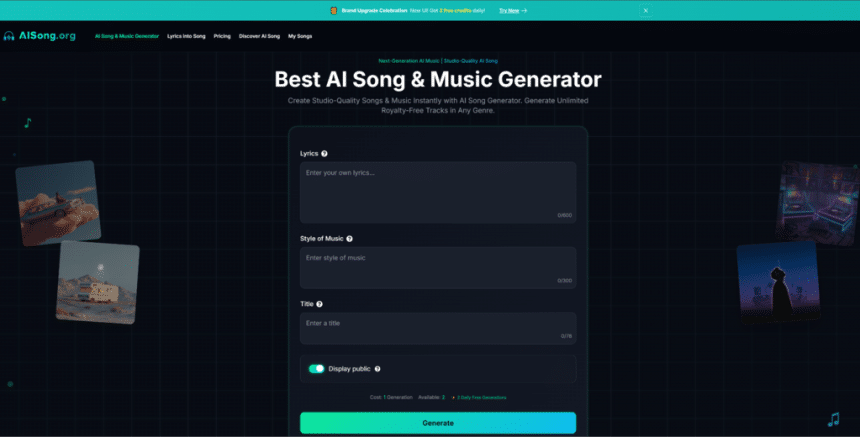
There is a particular kind of frustration that shows up when you have a musical idea but not a fast path to hearing it. You can describe the vibe. You can point to a genre. You can even write lyrics. Yet the leap from “intent” to “audio” still takes time, tools, and experience. That is why I ended up spending more time than expected with an AI Song Generator—not because it promised miracles, but because it offered a calmer promise: a quicker first draft.
In my own testing, the best way to describe the experience is this: it is a drafting partner that can be genuinely helpful when you need momentum, but it still expects you to bring clarity, taste, and patience. Sometimes you get a strong direction quickly. Other times you will need a few generations to arrive at something that matches your original mental picture.
Why This Category Exists: Music Creation Has an “Activation Energy” Problem
Even simple tracks have hidden complexity.
- Choosing tempo and groove
- Deciding chord movement and tonal color
- Selecting instruments that fit together
- Building a structure that feels intentional
- Keeping the arrangement from becoming cluttered
If you already live in a DAW, that complexity is manageable. But for many people—creators, marketers, writers, indie builders—the barrier is not imagination. It is activation energy: the work required to reach “something you can listen to.”
PAS: The common loop
- Problem: You need music, but the first draft is slow to build.
- Agitation: Without a draft, you cannot judge quality; you either procrastinate or settle for generic stock audio.
- Solution: Generate early drafts quickly, then refine only the options that are worth refining.
How It Works in Everyday Language
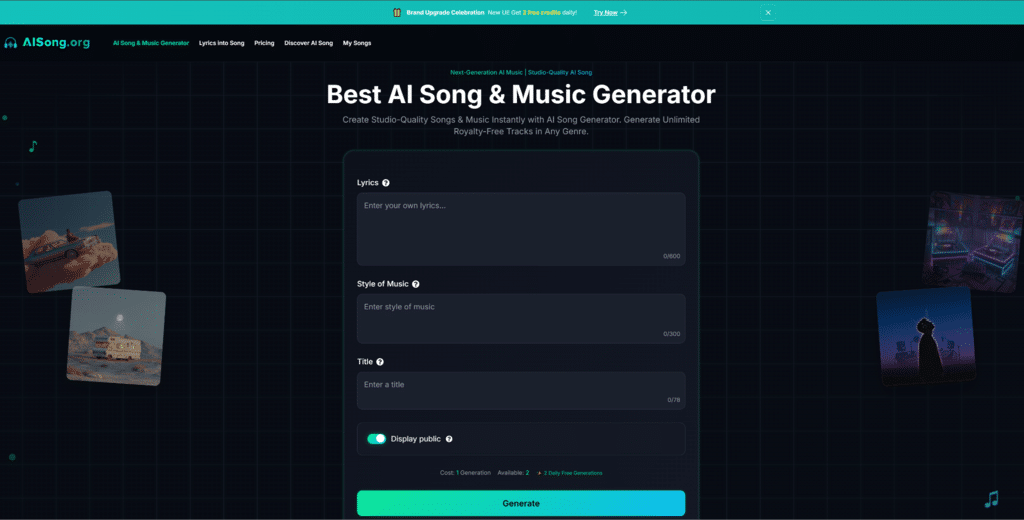
You provide either.
- A description prompt that includes genre, mood, tempo, instruments, and optional structure guidance.
- Or lyrics plus a style choice, so the system can map phrasing onto rhythm and a song form.
Then the system outputs an audio draft by synthesizing musical building blocks such as melody, harmony, rhythm, and arrangement into a track you can audition.
A detail that mattered in my testing: output felt more coherent when I treated the prompt like a production brief rather than a poetic wish.
Two Ways In: Choose Based on the Kind of Starting Material You Have
Description-to-Music: When you want a musical bed or theme
This is the fastest path when your goal is.
- Background music for short-form video
- A prototype for a campaign mood
- A “scene soundtrack” for a trailer or demo
- A starting point for composition
My observation: this mode benefits most from a clear instrument palette and tempo guidance. Without them, the arrangement sometimes introduced elements I did not want.
Lyrics-to-Song: When you want to hear words as performance
If you have lyrics already, the generator can help you quickly test.
- Whether the cadence is singable
- Whether the chorus is too dense
- Whether the phrasing matches the groove
My observation: line-length consistency matters. When lyrics were irregular, vocal phrasing occasionally felt cramped or unnatural. Light editing often helped more than switching genres.
A Different Perspective: You’re Not Buying Songs, You’re Buying Iteration Speed
It is easy to measure music tools by output quality. In practice, I found the more meaningful metric was.
- How quickly can I reach a confident decision about direction.
If the generator gets you to a “yes, this is the vibe” draft within a few iterations, it saves time even if you still plan to polish later. If it does not, you learn quickly that the idea needs a different approach.
Feature Comparison Table: The Most Honest Way to Set Expectations
| Workflow question | AI Song Maker | DAW workflow | Producer or composer | Stock music |
|---|---|---|---|---|
| Can I hear a draft today | Usually yes | Yes, but time-heavy | Often yes, but not instant | Yes |
| Can I explore multiple directions quickly | Strong | Labor-intensive | Limited by schedule | Limited by catalog |
| Can I control every note | Limited | Strong | Strong | No |
| Will results be consistent | Medium, prompt-sensitive | High | High | High |
| Best use | Ideation and first drafts | Final editing and polish | High-stakes production | Simple background |
| Typical tradeoff | Needs iteration | Time and skill | Cost and coordination | Generic feel |
What Made My Results More Predictable
Single-variable iteration beats endless regenerating
I got better outputs when I made single-variable changes.
- Same vibe, 10 BPM slower
- Less percussion detail
- More obvious chorus lift
- Switch lead instrument to guitar
- More space for voiceover
This turned the process from random retries into controlled exploration.
Structure cues improve coherence
Adding a simple roadmap helped.
- Intro four bars, verse eight bars, chorus eight bars, bridge eight bars, chorus eight bars
An avoid list reduces distracting surprises
This mattered more than I expected.
- Avoid harsh distortion
- Avoid busy hi-hats
- Avoid abrupt drops
- Avoid overly bright lead

Limitations You Should Hear Up Front
It is not deterministic
Two outputs from the same prompt can differ. That is useful for variation but frustrating if you want strict repeatability.
Vocals vary more than instrumentals
When vocals are involved, intelligibility and phrasing can fluctuate. In my testing, vocals improved when lyrics were concise and rhythmically consistent.
Some projects still need a finishing workflow
If you need a signature track with precise transitions, careful mixing, or tight arrangement control, you may still want DAW refinement or a human producer after you find the right draft direction.
Commercial use requires careful reading
If you plan to publish, monetize, or deliver client work, read the platform’s terms closely. Marketing phrases like “royalty-free” can exist alongside more detailed platform conditions; the practical permission boundary is in the specifics.
A Neutral Reference for Wider Context
If you want a broader, non-product-specific perspective on how generative AI is evolving across creative domains, it can help to read neutral reporting such as Stanford’s AI Index. It is not a product endorsement, but it gives a measured view of capability trends and adoption.
Who This Helps Most
Strong fit
- Creators shipping frequent content who need fast drafts
- Lyric writers who want to audition cadence quickly
- Teams building mood boards before commissioning final work
- Indie developers prototyping game or app soundscapes
Weaker fit
- Projects requiring surgical control over arrangement and mix
- Signature releases where every bar is intentionally designed
- Work where human interpretation is the core value
Closing: Used as a Draft Engine, It Becomes a Practical Workflow Tool
In my experience, an AI song generator is most useful when you treat it as a first-draft engine. You provide a clear brief, listen critically, and iterate with intention. The tool supplies speed and variation; you supply direction and taste. That division of labor is what makes the workflow feel grounded instead of magical.
Note
Outputs will vary based on prompt clarity, genre complexity, and the number of iterations. In my testing, adjusting one variable at a time produced more predictable improvements than generating endlessly without revising the brief.